

Blog

woman sitting in kitchen planning/dreaming with sticky notes all around

Are You Acting Without A Dream?

woman sitting in kitchen planning/dreaming with sticky notes all aroundHave you ever started doing something and then wondered why you’re doing it? I’m not talking about walking into a room and forgetting why you’re there or checking your email and forgetting you wanted to send a note to someone.

I’m talking about having a plan and acting on it. You’re a few steps in and suddenly you wonder: why am I doing this, how did I get here? This isn’t helping me get closer to my goals.

Sometimes it’s the shiny object that distracted you, sometimes it’s a goal that you suddenly realize is actually someone else’s (and not yours), and sometimes it’s the fear that if everyone else is doing it you should be too. However you got there, you find yourself doing something that isn’t really moving you toward your goals.

So, what happened? You started planning and/or acting without your dream, your why or your goal. Maybe it was someone else’s, but it wasn’t yours.

Why is dreaming important? It gives you your destination, it informs* your planning and it gives you the point in the distance to focus on.

I shared this quote on Twitter/Facebook the other day:

To accomplish great things, we must not only act, but also dream, not only plan, but also believe – Anatole France

Three questions for you:

  1. Are you acting without your own dream?
    Be brutally honest with yourself. Are you working without a dream? from someone else’s dream? Or are you clear about what your dream is and acting from there?
  2. What is your BIG dream?
    Why are you in business? What is your dream that puts enthusiasm into your steps (or actions)?
  3. Do you believe it is possible?
    If you don’t believe it is possible, all the dreaming and planning in the world won’t get you where you want to go. Harsh, perhaps, but it’s also honest. Sometimes, you can use other people’s belief in you. If you’ve ever had a coach or mentor you might have experienced this. Your coach knows you are capable of your dream and you believe in their faith in you until you have enough faith in yourself.

I’d love to know your answers to any of these three questions! I invite you to leave a comment and share your insights.
*One bit of clarification, when I write inform I mean to give substance, character, and to inspire. So, “it informs your planning” is another way of saying it gives substance or character to and inspires your planning.
photo credit: Victor1558 via photopin cc
Business Hours from store window

Why I Do Laundry During Business Hours

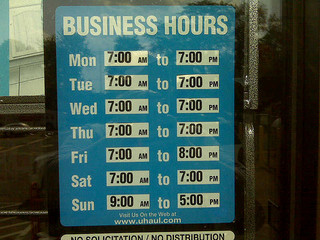
Business Hours from store windowIf you work from home, have you heard this advice: Never ever do housework during your business hours? I have. And usually, anything that tells me it’s okay not to do housework is great in my book! However, I break this rule regularly and usually on Mondays.

The title of this article gives it away. I do laundry during my work day. Why? Because it works out really well for me.

Rules like “Never ever do housework during your business hours” are guidelines. The purpose is to encourage you to treat your business seriously, make time for it and don’t get sidetracked doing other things (things that won’t help you pay bills). So, it makes some sense.

But why do I do laundry on Mondays? Well, my Mondays are usually a day for writing and getting some items checked off my to-do list. And it takes about 45 minutes or so for a load of laundry to finish, which is a nice block of time to get something done. It becomes a game for me – how far can I get on this task or how many of these items can I complete before the buzzer goes off?

Now, I do have a few of my own rules around doing laundry.

  1. It does not get put away during work hours unless it can’t go in the drier.
  2. Work comes before laundry. So, if I’m in the zone working on something, I won’t get up when the buzzer goes off. I’ll finish what I’m working on first.
  3. It does not run when I have calls scheduled (especially if I’m doing calls from the first floor). The buzzer is quite loud.

So, when I’m doing laundry I’m usually very productive, a lot gets done! And it surprised me at first – given that I was breaking a “rule” about working from home. But, like most “rules” they are just guidelines for you to use while determining what works best for you.

What business or productivity “rules” do you regularly break with great success? Let me know in the comments!

photo credit: tengrrl via photopin cc

Things To Do, Low Motivation and 3 Questions

Ever had a day where you just wanted to sit in front of the TV or maybe curl up with a good book or take a nap? It’s not that you didn’t have things to do; it’s just that you didn’t feel motivated to do them.

These days happen to everyone. You can push through it, give in to it or take a look at why it’s happening.

Here are some questions to ask yourself when you’re in this situation:

  1. Am I getting enough sleep?
    Many times low motivation is a result of too many late nights. Your body needs sleep to recharge. Try to get at least 7 hours, preferably more, of sleep tonight.
  2. What am I avoiding?
    Is there something that you’re avoiding? Another way to word this is: what am I afraid of happening if I complete this? Sometimes you have to dig a bit to figure out why you’re avoiding something.
  3. Do I have enough down time?
    If you’re always busy, whether business or family, you’ll wear yourself out. Your body and mind might decide that a day off is exactly what you need.

Go through and answer each question – especially if you’re not getting enough sleep. Why? Well, why aren’t you getting enough sleep? Answer the other two questions. Sometimes I find that I (or a client) am not getting enough sleep because I’m avoiding something or I’m taking some well-deserved downtime and missing out on the sleep.

For example, several years ago I had a job that I did not enjoy, at all. I regularly stayed up late and then got up early for work. I kept telling myself to go to bed earlier, but I didn’t. One night I realized I was staying up late because when you fall asleep, it feels like a few minutes later when you wake up. So, by staying up later, I was delaying going to work the next morning (ok, logically it might not make sense, but we don’t always do things logically).

So, I was staying up late to avoid work. Thankfully, that spurred some changes in my life at that time. Now, you might not be avoiding work. Instead you might be avoiding a particular task, a meeting or conversation or something else.

Once you know why your motivation is low, decide how you’re going to address it (what changes will it spur in your life). Meaning – if you’re not getting enough sleep, what can you do to make sure you get to bed earlier tonight? Basically, what’s your plan of action to avoid having this issue tomorrow?

But what do you do about today’s motivation low? Well, the plan of action might have given you some motivation, which is great! But it’s okay if that didn’t happen too. When your motivation is still low you have a couple of options left: push through it or take a break. Trust your intuition (or gut feeling) and decide what the best course of action is for you. It’s okay to decide to take a break. Sometimes that’s the most productive thing you can do.

What do you do when your motivation is low?

Two Forms of Overwhelm and What To Do About Them

This month’s teleclass topic was about “Ending Entrepreneurial Overwhelm.” And as I outlined the topic, I thought about was what causes it. How does it show up for me, how does it show up for my clients and other entrepreneurs I talk with?

It comes in many forms and the two I hear (or recognize) the most are:

  1. Information overload – “they” say I need to be doing this and this and that. And I’ve heard about this other thing I should be doing – Oh and then there’s this – and I can’t forget about that. But how do I find or make time for all of that?
  2. Everything’s started, nothing is finished – last month I started doing this, but then last week I decided I should really be doing this instead. And two days ago I decided I should do this too. So, I have a lot of things I’m working on right now! For some reason I just can’t get anything finished, I just run out of time.

Both of these have the same root cause –you’re focusing on too many things at once, specifically new things. I get it; new things have a bit of a new car look and smell to them. Then you get started on it and the “newness” melts away. You notice that maybe your new car isn’t as perfect as you thought. You’re not getting anywhere any faster than you were in the old car. And now you’re even more frustrated.

So, why are you focusing on so many things at once? Why is it when you pick out one thing to focus on you stick to it for a bit and then find yourself picking something else to focus on before finishing the first one (don’t worry, you’re not alone)? The reason is you don’t have clarity. Yes, you probably have a goal, make this much money or have this many clients or sell this much product, but you aren’t clear about which strategy to use to get there.

As a result, you jump from one strategy to the next. And none of them are really given enough time to determine if they work for you or not. So, pick one strategy and see it through. Purposefully work on each step and tweak as necessary.

The next question is: How do you get clarity? One of the simplest ways is to clearly define what you want and the strategy you’ll use to get there. Think of it like a taking a trip. If you’re going to Chicago, there are lots of different roads and methods you can take to get there. You pick out the way that makes the most sense to you and set out. Halfway through the trip it probably doesn’t make sense to decide to take the train. However, you could make a note that next time you’d like to take the train.

The strategies we use to reach our goals are similar. Once you plot out your strategy, stick to it. And if you come across another strategy on the way, make a note that you thought it was interesting and maybe next time you can use that strategy.

I’d love to know one of your goals and the strategy you’re committing to using to achieve it. Leave a comment and let me know!

We All Have 24 Hours in Our Day

Has anyone ever told you something like: You have just as much time each day as Thomas Edison and Bill Gates (or Steve Jobs). Everyone has 24 hours each day, no matter who they are.

Take a moment and notice your thoughts around this. What are you thinking? What are you feeling right now?

Generally, this kind of thing is meant to motivate you, to encourage you to spend your time wisely. And when I’m feeling overwhelmed with my goals or tasks, this sort of comment or quote annoys the heck out of me!

My thoughts tend to go like this: Good for them! They accomplished great things! Yes, I get your point, I can do that too – but how can I possibly do more in my day!?

Did you catch what happened there? I made an assumption. Based on my frustration and annoyance that I’m not “doing” enough it makes complete sense that I would make that assumption. Maybe you made the same assumption when you read it.

The assumption is that the purpose of the quote is to encourage me to do more each day. Be more productive, get more done, because obviously (another assumption here) the people who are more successful do more each day.

Is “doing more” the real purpose of pointing out everyone gets 24 hours each day? Maybe, maybe not. The real purpose doesn’t really matter.

What matters is how we interpret it. You interpret everything from where you are. So, at different points in your life, or heck, different points in your day, you will interpret the same sentence a different way.

When I’m tired, frustrated and overwhelmed I interpret everyone getting the same 24 hours as Bill Gates and Steve Jobs (or Mother Theresa for that matter) as someone telling me I should be “doing more” or “being more productive.” That time is something everyone struggles with daily.

However, at other times of the day you (and I) might view it differently. Here are some other ways to interpret it:

  • You immediately look at how productive you are and how you can improve it. Then you create strategies and plans to manage your time and stay productive! What doesn’t work for you today you’ll modify and do better tomorrow.
  • You think about all the different ways you can use your time (it’s kind of exciting!) and look for the ways you can make the greatest impact for others.
  • You think it’s really great that you get to choose how to spend your time. Maybe you’ll relax today or work on that project. Either way, it’s your choice and a great way to spend your time!

How did you respond to the “24 hours” comment?

How would you like to respond?

Leave a comment and let me know!