

Blog

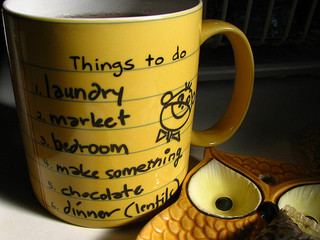
Mug with a things to do list on it

3 Problems that Create Overwhelming Task Lists

Mug with a things to do list on itWhenever I talk about task lists, whether in a presentation or with clients, I hear about how they’ve tried making lists, but it just doesn’t work for them. And if they had a system for keeping track of their goals and tasks that was working for them, then I’d leave it alone. However, they usually don’t.

When I ask why task lists don’t work, I generally hear something like:

  • It’s overwhelming to see everything I need to do in one place.
  • I make a list, stare at it and then go and do something else entirely.

This isn’t a problem of task lists not working – the problem is what’s on the list.

Here are the top three reasons your list isn’t working for you:

  1. The tasks are too big.
    Your tasks are things like updating your website, launching a program/product or paint the living room. Of course you’re frustrated and overwhelmed! Those are projects, NOT tasks (and you’ve created yourself a list of them!).

    Your task list is exactly that, a list of tasks. Instead of writing “paint the living room,” ask yourself what’s the next step? Have you picked a color yet? Maybe your next step is to look at colors at a store and grab a few examples to take home and review.

  2. The list is too long.
    Everyone has created lists like this. You’ve decided to write down everything that you need to do and before you know it; you’ve assigned yourself 20 tasks for the day. Again, you’re frustrated because you know that there is no possible way to complete all those items today.

    And you’re absolutely right. It won’t all get done. You’ve actually created a list of things to do over the next three or four days. Recognizing that and deciding what to complete today from that list will save you time and frustration. So, create a smaller list just for today. If everything feels like it HAS to be done today, take a look at last week’s article here.

  3. The important tasks are hiding between the trivial tasks.
    That looks like this: Clean off desk; Call Mom back; Email Jane; Write proposal for upcoming project; Make my inbox zero; Do the dishes; Wash towels.

    So, the really important thing, writing a proposal (or whatever it is for your business) is nicely hidden in the middle. You do all the “easy” tasks and run out of time at the end of the day for the really important one. Sorry, but that is not your task list not working for you – that’s you not working your task list.

    Always prioritize your list. Even if it’s not written with the most important item first, put a star or asterisk or something next to the highest priority item so it gets done first!

    Think of it like this – if someone says I want you to call your mom back, do the dishes, read all your email, take this $1000 bill and clean off your desk – what would you do first? Yep, you’re going to take that $1000 right away and then go do those other things.

    So, where is that $1000 on your task list? Find it and take care of that first.

What did I forget? What are your reasons for not keeping a task list? Share in the comments below.

photo credit: jessica wilson {jek in the box} via photopin cc

How To Choose Priorities When Everything Is Important

Have you ever had this situation: You’re looking at the list of things you want to accomplish this week and it feels like everything really should be done today. Everything is super important and can’t really wait until the end of the week. So, choosing what needs to be done today is frustrating, not to mention deciding what task you’re going to do next.

Sound familiar?

I had that experience this week. Between deadlines, emails, phone calls, meetings and other things I just wanted crossed off my list – it was extremely difficult to pick out what was really my highest priority.

I’ve heard other people say your highest priority tasks should be the things that will directly result in bringing in money or growing your business, but what about those items that won’t contribute to the bottom line now, but they’re a step in that direction?

Yeah, I was a bit frustrated.

So, this is what I did (and what you can do when you find yourself in a similar situation):

  1. Make a list of what you want to do this week (or even just today).
    If you already have that list, great! Mine was the undone things on my weekly list that had a few items added to it over the course of a couple days. I decided to rewrite it with just what was undone.

  2. In the margin, draw two lines down the page.
    My lines were about a centimeter apart. It doesn’t matter which margin it is, use whatever space is available on the paper.

  3. Label the one column Income and the other Deadline.
  4. Review your list for income generating tasks.
    Place a check-mark in that column. Now, you might be thinking: But I don’t have anything on my list that will directly result in me making money today, so I won’t be checking anything in this column.

    And if that were exactly what I meant by “income generating tasks”, then you’d be right. However, income generating tasks are also those tasks that might generate income later.

    So, that networking event that you plan to go to – belongs in this category.
    The phone calls you wanted to make to connect with people – yep, it counts.
    Creating a freebie for your website – you guessed it, it counts!
    Reading every email in your inbox – NOPE, that doesn’t count. It might be a nice distraction, but it can wait.

  5. Review your list for tasks that are part of a deadline that is in the 24 or 48 hours.
    Yep, you guessed it – place a check-mark in that column.

  6. Estimate how long each task with a check-mark next to it will take.
    And write it down next to the task!

  7. Decide your priorities.
    Anything that has a check-mark in both categories should be done first.

    And anything that doesn’t have a check-mark can wait a day or two (yes, I know you’d really like that item completed, but you’ve just identified it as not being a high priority).

    Now, for the income versus deadline items, you’ll need to make a call on those. I took a look at when the deadline was and how long each item was going to take and decided to do the income generating items first.

  8. Start working on the highest priority task!

One thing I’ve learned over the years is that 10 minutes of planning will save me a couple hours of being frustrated. It also means I don’t work late into the evening, because I’ve decided what can wait until tomorrow or next week.

What do you do to decide your priorities when everything feels important? Share below!

Image courtesy of “Stuart Miles” / FreeDigitalPhotos.net
why?

Do You Know Your WHY?

why?So, what is your WHY? And yes, I’ve capitalized it all on purpose, because it’s your big WHY and it is powerful. The WHY you do what you do.

There are two ways to answer this.

  1. The most common way is look at WHY you help the people you help, why are you passionate about it?
  2. The second way is more personal (yes, the first one is definitely personal too), what are the personal reasons WHY you do what you do.

The first type of answer covers why you are passionate about helping who you help. The second answer covers why it is rewarding to you or what it allows you to be/do. Coming up with generic answers to these questions isn’t working, so I’ll give you my answers:

  1. Why I work with the people I do, why I am passionate about my business:
    I was stuck for almost a year with goals that I wasn’t reaching, tasks that were never done and time that just seemed to disappear without me knowing what happened. It was really, really, really frustrating. And I couldn’t figure out how to change it for quite a while. When I did look for help, I didn’t find what I was looking for. Which was even more frustrating and I wondered if working for myself was just a horrible fit. However, the thought of being an employee again made my stomach hurt and deep down I knew I could do this. After I pieced together something that worked for me, I realized that I don’t want anyone else to feel that frustration and overwhelm that I had been feeling. And that’s why I’m now the Entrepreneur’s Productivity Coach – to help others create their own systems for their time, tasks and goals.
  2. Why I became an entrepreneur – and stay one:
    My husband and I want to start a family. We both wanted me to be home more than was possible as an employee. So, I started my own business (after spending several months exploring options while I was employed). Having my own business means I can set my own hours and goals (even though that wasn’t as easy as I initially thought). The biggest reason is so I can be an involved parent to my future kids. How do I know that’s my WHY? Because I tear up when I write it or think on it. That’s how important it is to me.

The first WHY is my passion for the people I work with. I know it’s my why because whenever I hear about someone struggling with these things I get it and know I can help (I can’t do the work for them, but I can help them on the path).

The second why is my really big WHY – and if you look closely, you can see the finger prints on my first answer. It’s what guided me toward entrepreneurship and keeps me here when things feel difficult. When I think on it (not just a passing thought) my eyes tear up and I really feel it.

Why is knowing the answers to these questions so important?

  1. Messaging. Your WHY is what you think about when you’re coming up with new products or offers. You think about it when you’re writing sales or opt-in pages. Your WHY is at the core of everything you do and how you describe it.
  2. Motivation. Your WHY is powerful and when things feel a bit scary, your WHY keeps you moving (and if your WHY doesn’t do that, it’s time to revisit and maybe revise it).

Basically, your WHYs color everything you do. Each goal you set ties back to your WHYs in one way or another. And if it doesn’t, well, that goal probably isn’t really that important to you.

Not sure what your WHY is? Ask yourself why you do what you do. When you have an answer ask yourself why again (why is that important to you)?

I’d love to know what your WHY is or any questions you have! Share in the comment section below.

Photo credit: e-magic / Foter / CC BY-ND

Preparing for 2013 – Part 3: What Does and Doesn’t Work

This week’s article is the third of three.

I’m going back to the basics for 2013 and I invite you to join me. This is what I’m doing:

  • I’m creating and solidifying routines (or habits).
  • I’m setting goals for myself that are supported by strategies and clear plans of action.
  • I’m tracking each goal and strategy.
  • I’m recognizing what does and doesn’t work for and making adjustments as needed.

Two weeks ago the article covered routines and the last week was about goal setting

Now, on to this week’s article:

Recognize what does and doesn’t work for you and make adjustments as needed

Sometimes things don’t work out quite as we want them to. Maybe you’d really like to get up at 6am every morning to get an early start to your day, but you don’t want to go to bed at 10pm (which would give you 8 hours of sleep). You’ve tried it and it just doesn’t work for you.

Guess what?! It’s not written in stone! If something doesn’t work for you then tweak it and do it a way that does work for you. You are not a slave to your goals! They are there to help you get to where you want to be. If you decide you want to get there a different way, great! Do it a different way.

And, as I mentioned a few times last month (here and here), many times you learn a lot more from your failures than you do from your successes. So, notice that something didn’t work, look at why it didn’t work, tweak the goal (or not) and move on.

Sometimes things work really well. And when that happens we sometimes don’t take the time to recognize the things we did that caused that. Instead we breeze on ahead to the next goal. However, there can be important things to learn from your successes! So, notice when something worked and why it worked. What was different? What did you do right? What did you do wrong that worked out for you?

Adjustments can be made to things that aren’t working for you and they can be made for things that are working for you. I’m not advocating changing everything that’s working, but I am asking you to take a look at what’s working and if you see a way to leverage that, go for it! Also, look for other places you can apply that success.

For example, perhaps one of the reasons a promotion went really well was because you were genuinely excited about it – you just couldn’t wait to share it with others! This is a great place to look at why you were so excited about it. What was it about that promotion that got you all fired up? What would it take to have that excitement or fire about other parts of your business?

So, take a look at what didn’t go well last year and what went really well. What were some of the factors that contributed to those things? How can you use that information when setting your goals or working on your to-do list?

I’d love it if you shared some of your observations on what works and doesn’t work for you in the comments below!

What are your goals?

Preparing for 2013 – Part 2: Goals and Strategies

What are your goals?This week’s article is the second of three.

I’m going back to the basics for 2013 and I invite you to join me. This is what I’m doing:

  • I’m creating and solidifying routines (or habits).
  • I’m setting goals for myself that are supported by strategies and clear plans of action.
  • I’m tracking each goal and strategy.
  • I’m recognizing what does and doesn’t work for and making adjustments as needed.

Last week’s article covered routines and the next week is about recognizing what does and doesn’t work

Now, on to the details for goal setting:

Set goals that are supported by strategies and clear plans of action

So, you have a goal in mind. What strategies will you use to meet that goal? What are the steps to complete each strategy?

A goal can have many supporting goals or strategies.

For example, take a basic goal like making a certain amount of money each month. That’s the main goal right? Now, how will you do it?

By meeting people? How will you meet them and stay connected? Perhaps you’ll network a certain number of times each month and begin speaking at different events.

Well, now you have two supporting goals: networking and speaking. What are your goals for those things? How many times do you want to network each month or how many people do you want to meet? How will you prepare for speaking or how many times do you want to speak each month?

So in this example the main goal is a certain monthly income, the supporting goals/strategies are networking and speaking and the steps to complete the supporting goals are what needs to be done to meet those supporting goals.

One hint here: If you want to start something new, the initial goal might be to research how to do it. The next goal might be to do it.

Track each goal and strategy.

Goals are easy to set and even easier to lose sight of if you’re not tracking them. This means looking at where you are with each one on a weekly basis.

The easiest way to do this? Make each goal specific and give it a due date.

In the example above the main goal was to make a certain amount of money each month. So, determine how you’re going to track it. One way is to take a piece of paper, write down each day of the month and then at the end of each day write down the amount of money you made and the total for the month. Slowly you’ll see the number grow.

If your goal is have 5 sales a month, then draw five circles on a piece of paper or sticky note and fill them in as you make your sales.

And of course, there are some goals that are simply, did this get done or not.

I have each of my goals on a post it note and they’re sticking in a notebook that holds all master and weekly lists. It’s easy to find and update them at the end of the week (or daily) that way. Many people post those goal tracking sheets in a place they every day and can easily update.

What goals do you have for 2013 and how will you track them? Share in the comments below!