Happy Girl

I’m Only As Happy As I Decide To Be?

Happy Girl

“People are about as happy as they make up their minds to be.” – Abraham Lincoln

I’ve been thinking about this quote a lot the last two days. And I wonder: Do you agree with it?

I go back and forth with it. I agree because we always have choices about how we feel and act in any situation. So, if you’ve made up your mind to be happy (or unhappy for that matter) you’re much more likely to have that result.

However, I disagree because I have these voices in my head that tell me I’m not good enough and that no one really wants to hear what I have to say. These voices pop up regardless of me deciding to be happy. And they can be really hard to shut up!

Like I said, we get to choose how we feel and act in each situation we are in. For me, part of that choice is recognizing when those voices pop up and deciding if I’m going to listen to them or not. And I run into problems when I don’t recognize the voices for what they are and listen to them.

Those voices have appeared a lot for me this week. And I retreated into myself quite a bit, because that’s more comfortable than putting myself out there. Today I recognized it for what it was and noticed one big change from how I would have reacted last year or even a few months ago. I started to beat myself up over it and then realized beating myself up over it only makes me feel worse and doesn’t move me forward. So, I recognized what was happening, forgave myself, and then moved on with my day.

I’m committed to being happy, but it doesn’t always come easy. And that’s my problem with the quote. It makes it seem so cut and dry, but we do have to start somewhere and a decision to be happier is a good place to start.

Tell me what you think. Do you agree or disagree with the Abraham Lincoln quote?

Photo credit: happy jumping girl by River Beach via flickr

Here’s Why It’s Not My Fault

This is the third and last post in this series. The first can be found here and the second here.

There was a time of my life when I absolutely dreaded being called into someone’s office, because it generally meant one of three things:

  1. I was going to be given more work to do (I already had too much to do and not enough time to do it).
  2. I was going to sit through a meeting that wasn’t going to do anything for me other than take time away from my other tasks.
  3. I was going to be “yelled at” for something falling through the cracks because I was working on other higher priority issues and now this thing was the high priority.

No option was something I wanted to spend my time on.

This is the last of three posts where I’ll go through one option and review how I reacted and an alternate that might have made me (and the people around me happier).

3. I was going to be “yelled at” for something falling through the cracks because I was working on other higher priority issues and now this thing was the high priority.

How I reacted:
I was immediately on the defensive. Explaining why it had fallen through the cracks: I had lots of other high priority, fix it now issues that I was looking at. Oh, and the client didn’t express that this was an important issue when I was reviewing their other high priority issues with them. Basically, I was saying that it’s not my fault and these are the reason why.

An alternate:
First, I want to take a look at the start of the sentence: “I was going to be ‘yelled at.'” Actually, it was rare for me to walk into an office and hear a raised voice in my direction. The times I do remember raised voices were generally after I explained why something wasn’t my fault and took no responsibility for a problem I helped create.

I very rarely accepted responsibility for something falling through the cracks. It pains me to say that now (I’d rather not admit it and avoided writing this post so I wouldn’t have to revisit it). Responsibility and honesty are two important values for me. I wasn’t honest with myself about what was happening and thus avoided taking responsibility for some messes I caused or contributed to.

At the time I didn’t realize that part of the problem was that I wasn’t taking responsibility for my role in things. I felt I was doing the best I could with each situation and I wanted to avoid being “in trouble” as much as possible. “Yelled at” was another way I worded being “in trouble.”

Making a mistake and thus being “in trouble” meant I had done something bad and I would beat myself up over it. At some point I realized that making mistakes is just something that people do unintentionally. It’s not good or bad, it just is. And instead of beating myself up over it I can look at what actions led up to the mistake and what I can do differently in the future.

When I was able to reframe making mistakes, I was also able to take more responsibility for my actions (or inactions) and the results. One side effects of taking responsibility for my part in problems was it was easier to describe what the problems were. My focus had shifted away from making sure I wasn’t going to get “in trouble” to solving the problem.

So, while I wasn’t taking responsibility for things I should have been, the real issue was that I didn’t want to be “in trouble.” Have you ever had a similar experience?

Ugh! Another Meeting

This is the second of three posts in a series (the first).

There was a time of my life when I absolutely dreaded being called into someone’s office, because it generally meant one of three things:

  1. I was going to be given more work to do (I already had too much to do and not enough time to do it).
  2. I was going to sit through a meeting that wasn’t going to do anything for me other than take time away from my other tasks.
  3. I was going to be “yelled at” for something falling through the cracks because I was working on other higher priority issues and now this thing was the high priority.

No option was something I wanted to spend my time on.

This is the second of three posts where I’ll go through one option and review how I reacted and an alternate that might have made me (and the people around me happier).

2. I was going to sit through a meeting that wasn’t going to do anything for me than take time away from my other tasks.

How I reacted:
My thoughts upon learning I would be in a meeting were generally along the lines of: Ugh! Another meeting that I have to sit through when I could be doing something productive! Why do I need to waste my time there? I don’t have anything useful to contribute, and if I do it will be dismissed. And even though it’s only scheduled to take 30 minutes, it’ll go for at least 45, because they won’t start until everyone’s there and that will take at least ten minutes. And that’s if we don’t sit waiting for someone for a bit and then get told that they’re stuck in some other meeting or on a support call, and then we get to go through the whole process again! Ugh! Why can’t I just stay at my desk and get my stuff done?

An alternate:
First, spending time waiting for people to show up at a meeting can be really frustrating. However, one thing that never crossed my mind was that I was late pretty often too, or couldn’t make it, due to another meeting running long or being on a support call. Some how though, that was acceptable behavior for me, but not for others. I don’t think I realized that I was contributing to the same behavior that I found so frustrating. In this case, I could have acknowledged that I was frustrated and perhaps noted my own contribution to it and then moved on to something else.

I also automatically assumed that my opinion would be dismissed. When you make a suggestion or share an opinion with the thought in your head that it’s going to be dismissed, other people pick up on that. Why should they spend time exploring a suggestion that you don’t believe in? However, when you believe in your suggestion, that confidence is shown in your tone and body language. Others are much more likely to spend time exploring a suggestion they can tell you have confidence in.

While I was in meetings I was so absorbed with thinking about the things that I needed to get done at my desk that I wasn’t paying very close attention to the meeting. So, of course I wasn’t getting a lot out of the meeting or contributing to it! When I went into the meetings with an open and positive mind (meaning I wasn’t walking in saying “this is a waste of my time”) I got more out of the meetings, contributed more and occasionally (shh, don’t tell anyone) had fun! And when I went in with that attitude, waiting for ten minutes for a meeting to happen wasn’t so frustrating. Instead, I was able to talk with people I might not see on a regular basis and catch up with them. And if the meeting didn’t happen, it felt more like a nice break then a waste of my time.

What you expect, you get. When I expected an experience that wasted my time and was frustrating, I pretty much always got it. And when I expected an experience that would be useful and helpful to me (and maybe even fun), I pretty much always got that too. The people and the meetings didn’t really change, but what I expected out of the meetings did change.

What are your thoughts on this?

What! More Work?

There was a time of my life when I absolutely dreaded being called into someone’s office, because it generally meant one of three things:

  1. I was going to be given more work to do (I already had too much to do and not enough time to do it).
  2. I was going to sit through a meeting that wasn’t going to do anything for me other than take time away from my other tasks.
  3. I was going to be “yelled at” for something falling through the cracks because I was working on other higher priority issues and now this thing was the high priority.

No option was something I wanted to spend my time on.

In this and the next two posts I’ll go through one option and review how I reacted and an alternate that might have made me (and the people around me happier).

1. I was going to be given more work to do (and I already had too much to do and not enough time to do it).

How I reacted:
My outward reaction depended on who was giving me the task. If it was someone I felt fairly comfortable with I might let them know that I was frustrated I was getting additional projects or tasks. If it wasn’t someone I felt comfortable with I’d say “Ok”, get any details I needed and head back to my cube. In either case I was annoyed and frustrated that something else was being “dumped” on me.

I also wondered if anyone actually appreciated the work I got done, because it felt like as soon as I got something done I got two or three more things to do. I felt punished for getting work done in a timely manner sometimes.

An alternate:
Instead of being upset and complaining to myself that things were being “dumped” on me. I could have made a request to that something else be taken of my plate or a deadline be moved. I was extremely reluctant to speak up for myself because I was sure I would be shot down. The biggest problem with thinking like this is that I never tried so I can’t actually say what would have happened.

This also ties into not complaining. Complaining lowers your energy, both mentally and physically. I spent so much time complaining about what I was doing and what I had left to do that I wasn’t putting as much attention into what I was working on.

Also, take a look at the language I was using. I felt “dumped” on. Of course I wasn’t going to be happy doing whatever task was just assigned to me! Changing my language to a more neutral tone would have made a difference. Instead of saying a task got dumped on me, I could have just as easily said I have a new task.

As for being appreciated, I found very little of what I was doing to be “fun,” so I wanted to be appreciated for all the “not fun” things I was doing. Well, no one was going to pat me on the head and say good job every time I did something that was my job to do. I don’t mean that harshly, it’s just the truth. Another truth is if you go into something dreading it and thinking about all the other things you’d rather be doing (things like not being at work), then you’re not going to enjoy what you’re doing.

The ironic thing is that I wasn’t appreciating what I was accomplishing each day. If I’m not appreciating what I’m getting done, why would someone else? Taking 30 seconds after completing a task to allow myself to feel a sense of accomplishment could have made a big difference.

What would you recommend someone do in a situation like this? Let me know in the comments.

Photo credit: Just working with some…FRUSTRATION! by [ jeremy ] via flickr

2011 Word of the Year – Update

It’s been exactly six months since I wrote about selecting my 2011 Word of the Year: engaged. So, this is a good time to review how this word has challenged me and how I’m doing with the strategies I came up with.

I still find myself struggling a bit with the word “engage” and found that default settings aren’t called that for nothing. Anytime you’re trying to change your default, you need to work on it. I’ve been reminded of this a few times so far this year.

I still struggle with jumping from one task to another. Generally it’s to check email or facebook or something like that “really quick.” The good news is that I more readily recognize when I’m doing it. The bad news is that I sometimes don’t realize it until a half hour has gone by. Yesterday I downloaded a tool recommended to me by a friend. One feature of the tool is to watch and time what sites you visit. If you spend too much time (you can set this) on a non-productive site, it will let you know.

Another default setting is the tendency to withdraw into myself when I’m in a new or uncomfortable setting. Like I said six months ago, I like to get a lay of the land before I participate. I’m doing better with this one. I’ve consciously dove into conversations a couple times when I wasn’t completely comfortable. There are times when I’m uncomfortable and I don’t dive in, but I recognize those situations more as they occur and look at what it is that makes me uncomfortable. Looking into why I’m uncomfortable has been extremely useful.

I’m doing pretty good with staying involved in activities that I feel fully engaged in. Even when I find myself coming up with excuses not to go before hand, they tend to be pretty rewarding. Sometimes the reward is that I felt the uncomfortableness and went and had a good time anyway! I found one of my favorite groups this way.

So, how am I doing with those strategies I came up with?

  • Set an intention for each meeting/event/outing I attend. I don’t always do this. The times when I don’t set an intention, I tend to have a more frustrating experience. However, when I do set an intention things go pretty well. Sometimes the intention is simply to have a good time and that’s enough. Intention setting for meeting, events and outings is important to me because they remind me why I am there and what I hope to accomplish.
  • Only attend meetings/events/outings that I have a high potential to feel fully engaged in. I’ve done a good job with this one. I stopped attending a meeting I really enjoyed, but didn’t feel fully engaged in to try another meeting that I thought had a bit more engagement potential. It paid off! I love attending the new meetings and am fully engaged. And, I continue to sign up for events that are outside of my comfort zone, but I feel have potential.
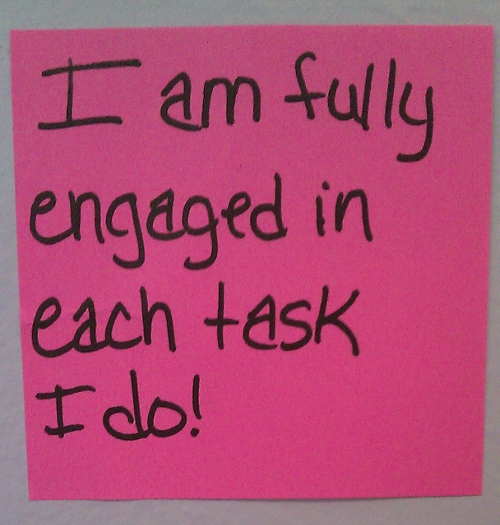
  • Set an intention for each day. I haven’t done this one for a while. The main reason is I generally had the same intention for each day: I am fully engaged in each task. Actually, I think I’ll write that down and post it in my office right now (see the picture above).
  • Meditate daily. I did this daily for about a month and for some reason stopped. This is definitely something I want to recommit to.
  • Set goals for each week. About two weeks ago I pulled out my six month goal list and broke it down into individual tasks and assigned them to specific days. This has worked out pretty well for me.
  • Set goals at the beginning of each day (or the end of the previous one). In April I got an accountability partner. We talk each morning and tell each other our goals for the day and how we did with the previous day’s goals. This has been a GREAT help to me. I found it was even more useful when I made sure I had my goals for the day listed before we got on the call so I wasn’t coming up with them as we talked. That’s where setting up the tasks in advance really paid off. Some things still get moved, but they all get rescheduled.

These are the strategies that I’m recommitting to:

  • Set an intention for each meeting/event/outing I attend.
  • Only attend meetings/events/outings that I have a high potential to feel fully engaged in.
  • Meditate daily.
  • Set goals for each month based on my long term goals.
  • Set goals at the beginning of each day (or the end of the previous one).

Did you select a word of the year? How are you doing with it?